
Bedford began as Bedford Park, a townsite proclaimed in 1937 in country once known for dairy farms and lakes.
How Bedford got its name
Landgate records that the area was called Bedford Park after subdivision by the International Investment Land and Building Co. Ltd. of Sydney and Gold Estates of Australia, an English company, and that the name honours Admiral Sir Frederick George Denham Bedford, Governor of Western Australia from 1903 to 1909. Landgate describes the suburb as a product of the gold boom of the 1890s and early 1900s. A proclamation signed on 11 June 1937 and published in the Government Gazette on 18 June 1937 declared part of Swan Locations V and W, in the Bayswater Road District, to be a townsite known as Bedford Park. The suburb is now simply Bedford.
Before the suburb
The City of Bayswater’s thematic history places the district within the Whadjuk dialect groups of the Noongar peoples. From the mid 1890s, it says, dairies run by Edward Browne, Robert Meakins and Paul Rychen stood on the sites of today’s Hillcrest Reserve, St Peter’s and land north of Beaufort Street. Two lakes lay nearby. Meakin’s Lake covered what is now St Peter’s oval, and Brownes’ Lake, across Coode Street north of Beaufort Street, held back settlement towards Morley until it was drained in about 1960.
How it grew
This was an isolated corner of the district. A Grand Promenade house built by William Hay in 1912 was one of only three in the street, with no made roads, and its bricks had to be carted from the Peninsula Brickworks. The extension of Beaufort Street into the district in 1924 started real settlement, and Bedford Park had a building boom through the Depression. The Perth Electric Tramway Society records the tram reaching Grand Promenade during the Second World War, before trolleybuses replaced it on 19 July 1958.
After the war, building in Bedford Park was the Commonwealth and State governments’ first major activity in Bayswater. The State Housing Commission also built shops on Grand Promenade, designed by architect William Leighton. Bedford Park School became Hillcrest School in 1951.
Places that tell the story
The Bedford War Memorial in Remembrance Park was built in 1958 and 1959 by the local Returned Servicemen’s League. The site first chosen was across Salisbury Street, but it moved to avoid being close to the hotel. Houses at 104, 106 and 108 Salisbury Street are on the City’s heritage list as examples of early Bedford Park. St Peter’s Church and Hall opened in 1938, and St Peter’s school started in 1941.
Bedford today
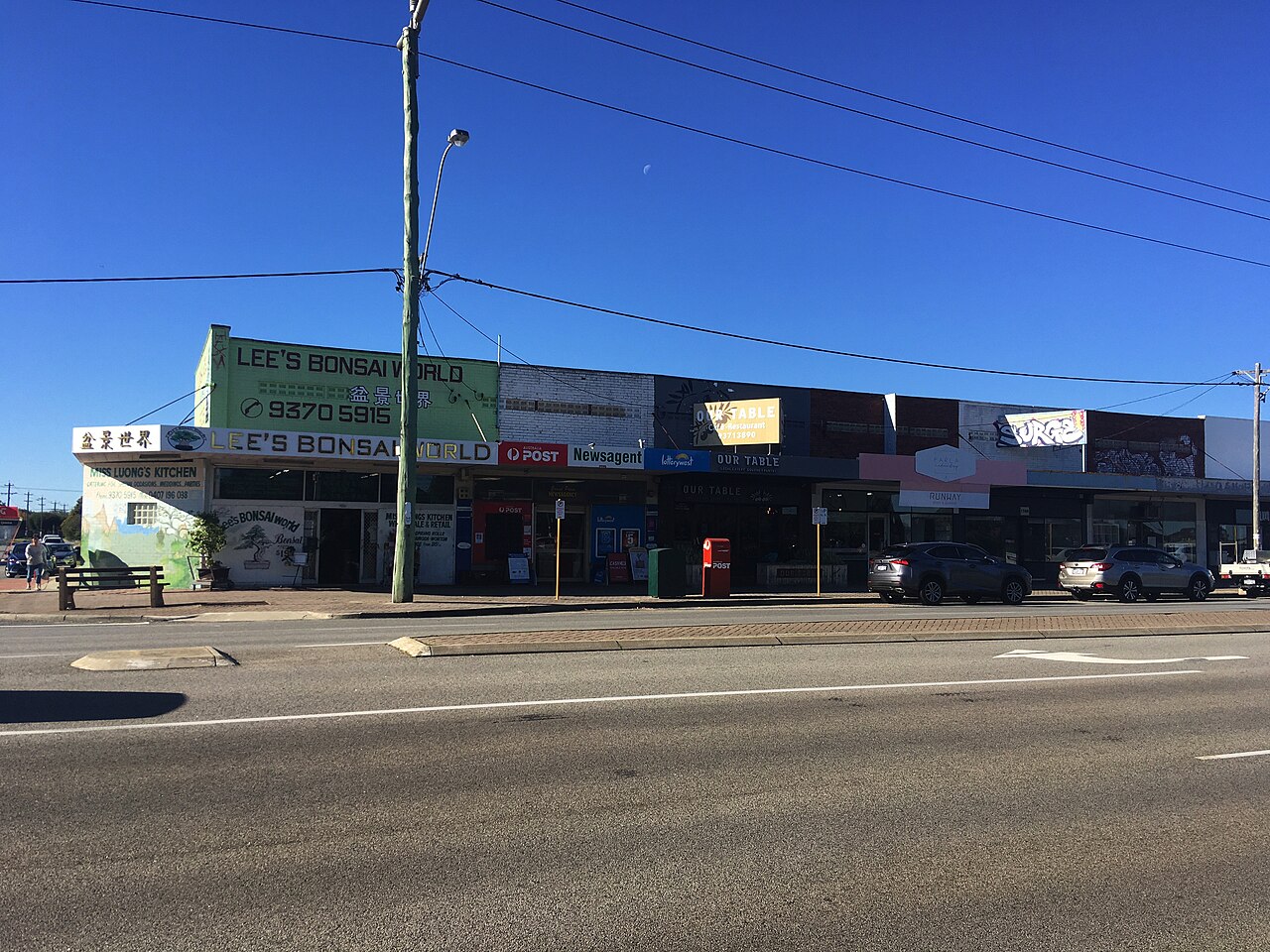
Beaufort Street is still the spine, now carrying the high frequency 950 bus, and in 2023 the City refreshed the Grand Promenade shops with murals and outdoor dining.
More about Bedford
For what Bedford is like to live in now, read our Bedford suburb profile. If you own a property in Bedford and are thinking about selling, start with buyers for your property.
Sources
- Landgate: Perth and surrounds suburb names (archived 2022)
- Government Gazette of Western Australia, No. 29, 18 June 1937: Bedford Park townsite proclamation
- City of Bayswater: Local Heritage Survey Thematic History and Framework (2020)
- City of Bayswater: Local history
- inHerit: House, Grand Promenade, Bedford
- inHerit: Dwelling, 104 Salisbury Street, Bedford
- inHerit: Bedford War Memorial and Remembrance Park
- Perth Electric Tramway Society: Perth tramways
- State Records Office of WA: Hillcrest Primary School
- St Peter’s Primary School: school history
- City of Bayswater: Grand Promenade shopping precinct brought to life (April 2023)
Top image: Remembrance Park and the Bedford War Memorial, on the corner of Salisbury and Beaufort Streets, 2012. Photo: Orderinchaos, CC BY-SA 3.0, via Wikimedia Commons.
Dates and names are drawn from the sources above. Where sources differ, we have said so or given an approximate date.
By Key Performance Real Estate, 338 Beaufort Street, Perth
Category
Buying
Related Posts
Get an up to date obligation free market appraisal
One of our agents will visit your property to provide a professional, obligation-free market appraisal.