
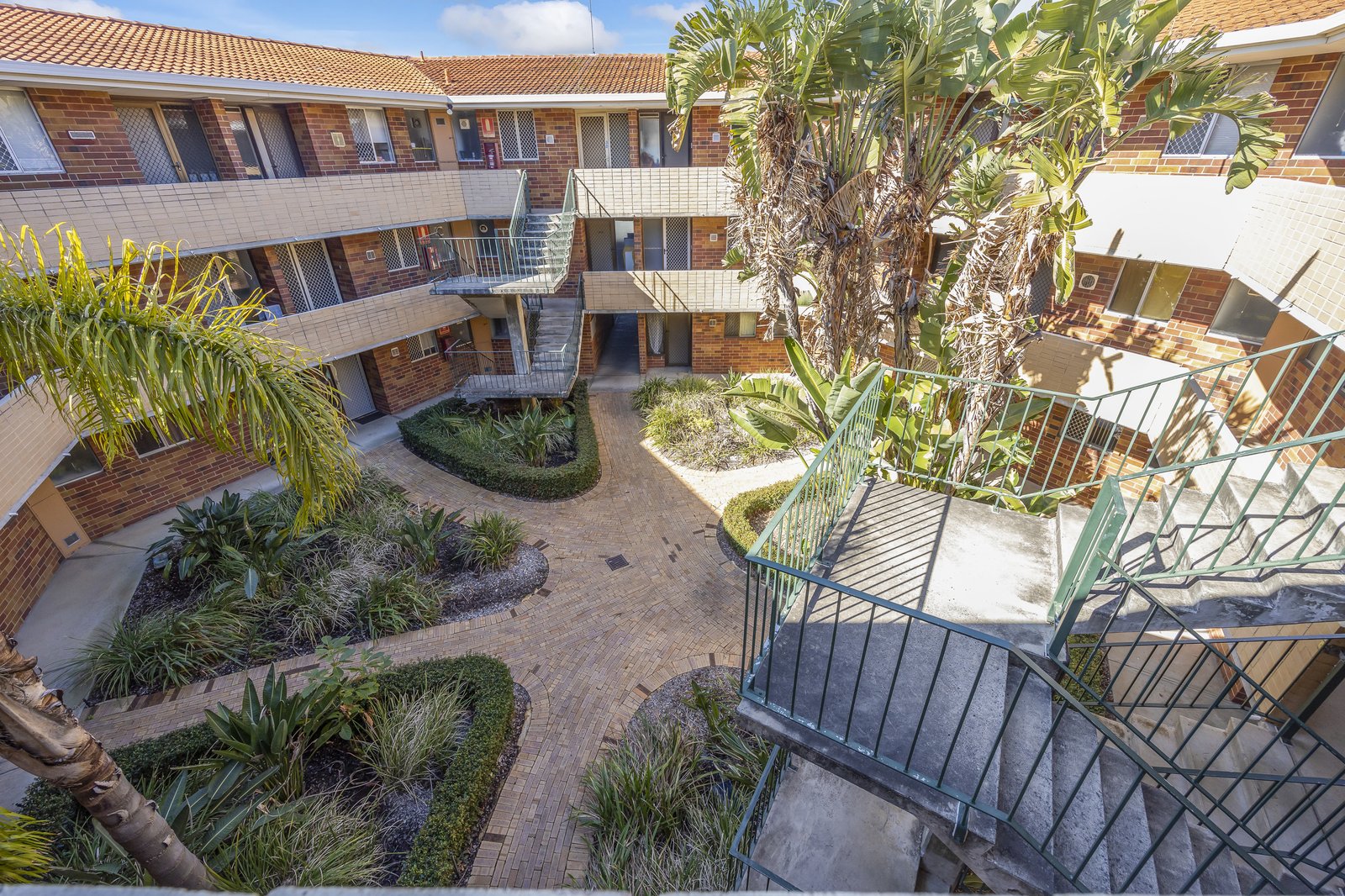
If you want to understand how Perth property really works, do not study houses. Study the older units: the one bedroom flats of Highgate and Mount Lawley, the two bedroom walk-ups on Herdsman Parade in Wembley, and the salmon brick complexes of the 1960s and 1970s that line the inner-city corridor. Locals will also know the distinctive hexagon blocks at 1, 19, 25, 47 and 49 Herdsman Parade in Wembley, 81 King William Street in Bayswater, 31 First Avenue in Mount Lawley, and 2 Bennelong Place in Leederville, buildings whose story we tell in salmon brick, hexagons, and a Games mystery. These are the purest cycle stock in the market, and over forty years they have told the same story again and again. Director James Yeoman has sold strata property through these suburbs since 1998, and his sales records anchor the account below.
The 1980s: the first hard lesson
The cycle did not start in the 1990s. Perth boomed through the mid 1980s, with the median house price running from $52,050 in 1985 to $102,500 in 1989. Then mortgage rates hit 17 per cent in 1989, loan commitments in WA fell by more than 40 per cent between 1989 and 1991, and the median was back below six figures by 1991. Units copped it hardest. When the cost of money doubles, the stock that is priced on money, rather than on land or scarcity, is the stock that falls first and furthest. That is worth remembering every time someone tells you units are a safe little corner of the market: they are the most interest-rate-sensitive property in Perth, in both directions.
The late 1990s: priced off the bank account
In the late 1990s you could buy a one bedroom flat in Highgate or Mount Lawley, or a two bedroom flat on Herdsman Parade in Wembley, for around $45,000. They rented for about $90 a week, and after strata levies, council rates, and water rates, the net return worked out at roughly 2 per cent above what the same cash earned in the bank. That was the whole pricing model. Nobody bought these units for growth. They were priced like a slightly better term deposit with a front door, and the market was calm because the arithmetic was honest.
1 July 2000: the grant changes everything
When the GST arrived on 1 July 2000, it brought the $7,000 First Home Owner Grant with it. On a $45,000 unit, that was more than 15 per cent of the purchase price handed to the buyer, and the effect was immediate. First home buyers poured into exactly this stock, prices jumped well over $100,000 in the early 2000s, and the long boom that followed carried the same units to around $320,000 by 2014 and 2015. The grant itself did not sit still. During the global financial crisis the Commonwealth boosted it to $14,000 for established homes from October 2008 to September 2009, stepped it down to $10,500 until the end of 2009, then returned it to $7,000. In 2013 the WA Government cut the established-home grant to $3,000. Through all of it, the message to buyers of this stock was the same: the government will help you in. A unit that had been priced like a term deposit was now priced like a growth asset, and the yield logic that had anchored it for decades quietly disappeared.
2015: the support is removed
In October 2015 the WA Government abolished the First Home Owner Grant for established properties entirely, the $3,000 that remained of it, leaving established-home buyers with only the stamp duty concession. It happened just as the mining construction boom unwound, and the two forces together took the floor out of the older unit market. The wider housing market fell; these units fell harder. By 2019 and 2020 many had roughly halved from their peak. At 50 Kirkham Hill Terrace in Maylands, sales KPR tracked went from $325,000 in 2015 to around $145,000 near the bottom of the market. Owners who had bought at the top were carrying loans worth more than the property beneath them.
The bottom: back on the yield curve
Here is the part almost everyone misses: the bottom was not irrational. By 2019 and 2020 the Reserve Bank had cut the cash rate to historic lows, reaching 0.10 per cent in late 2020, and the bank was paying savers almost nothing. Rents were low after years of oversupply. So a unit returning about 2 per cent net after strata and rates was once again exactly where the late 1990s model said it should be: roughly 2 per cent above the bank. The market had not broken. It had gone home to yield.
2022 to 2026: scarcity does it again
Then Perth ran out of accommodation. By 2022 and 2023 there were dozens, sometimes a hundred, applicants presenting for a single rental, rents surged, and the cycle turned hard. The same older units flew. At the top of the market in early 2026, a two bedroom flat in Maylands was fetching $585,000 to $600,000 in sales we handled and tracked. Only months later, in August 2026, the same property would sell for around $500,000. For context, REIWA’s Maylands median unit price, which includes the newer apartment stock, sits at $615,000 as at August 2026. The top of this cycle, like the last one, was set by scarcity and sentiment rather than by rent.
Where it goes from here
These units move on yield, and we expect them to fall back towards yield again, just as they did at the bottom of the last cycle, when they settled at a net return of about 2 per cent above bank deposits. With the bank actually paying interest today, that arithmetic sits well below recent peak prices. That is not a prediction of the week or the month; it is the gravity these buildings have obeyed for forty years. This time, though, the landing may be softer than 2015 to 2019. Perth house prices now sit at many multiples of household incomes, and for a large share of home buyers and first home buyers a unit is the only affordable way in. That owner-occupier pressure, buyers who need a home rather than a return, barely existed in past downturns, and it should cushion the slide back towards yield even if it cannot repeal it.
The lesson, especially for first home buyers
The saddest conversations of the last downturn were with people who bought these units as first homes at the 2014-15 top. By the bottom their properties had halved, and they were young people whose lives had moved on: a partner, a wedding, children on the way, a house needed. They could not borrow because the loan exceeded the property, and they could not sell without bringing money to settlement, so they could not start the next chapter. The grant that helped them in had no opinion about what they paid. We may be seeing the same conditions forming again now.
None of this means do not buy. It means buy on the arithmetic: the rent, the levies, the rates, the net yield against the bank. If the numbers make sense on yield, the cycle is your friend at one end and survivable at the other. And whatever the cycle is doing, well bought tired units keep rewarding renovators, as we explain in tired units, cheap rent, and the $150,000 difference. If you are a first home buyer, read our First Home Buyers guide to the schemes and their deadlines before you use them. If you are an investor, our Investment Buyers guide covers the duty, tax, and tenancy detail, and the honest pros and cons. And if you want to know what any specific unit should be worth on its rent, ask us. That is the question we have been answering here since 1998.
Past performance is not a prediction. Historical figures above reflect KPR’s sales records and recollections of the markets described, alongside published data where noted. This article is general information, not financial advice.
By James Yeoman, Director of KPR Perth Pty Ltd T/A Key Performance Real Estate
Related Posts
Get an up to date obligation free market appraisal
One of our agents will visit your property to provide a professional, obligation-free market appraisal.