
Inglewood sits on Beaufort Street between Mount Lawley and Bedford, and its numbered avenues, bungalows and Beaufort Street landmarks all trace back to one land company and a tram line it helped pay for.
How Inglewood got its name
The City of Stirling says the name is thought to come from a Norwegian barque called Inglewood, whose voyage was reported in The West Australian on 24 May 1904. The council records this as the likely origin rather than a certainty.
Before the suburb
Land in the area was first granted to John Gregory in 1831, with later grants to J. Birkett and Mary Hutton. For many years the district was thought of as part of Maylands rather than a suburb of its own.
How it grew
Gold Estates of Australia began surveying the land before 1906. The first section to be subdivided was the one now known as The Avenues, running from the railway line through to Eleventh Avenue and Dundas Road. The later section became the Inglewood Estate, which took nearly 20 years to sell.
Transport made the estate saleable. In 1909 Gold Estates agreed to help pay for extending the tram line from Walcott Street to Second Avenue, and the tram finally reached Dundas Road in 1929, an event celebrated locally.
The City of Stirling records two building booms: from 1904 to 1920, when single houses were built for a largely blue-collar population, and again from about 1935 to 1940. Most of the older houses are Federation or Californian Bungalow in style, many since renovated and restored, with flats added from the 1960s.
The first primary school opened in Second Avenue in 1927 and later became the Inglewood State School.
Places that tell the story
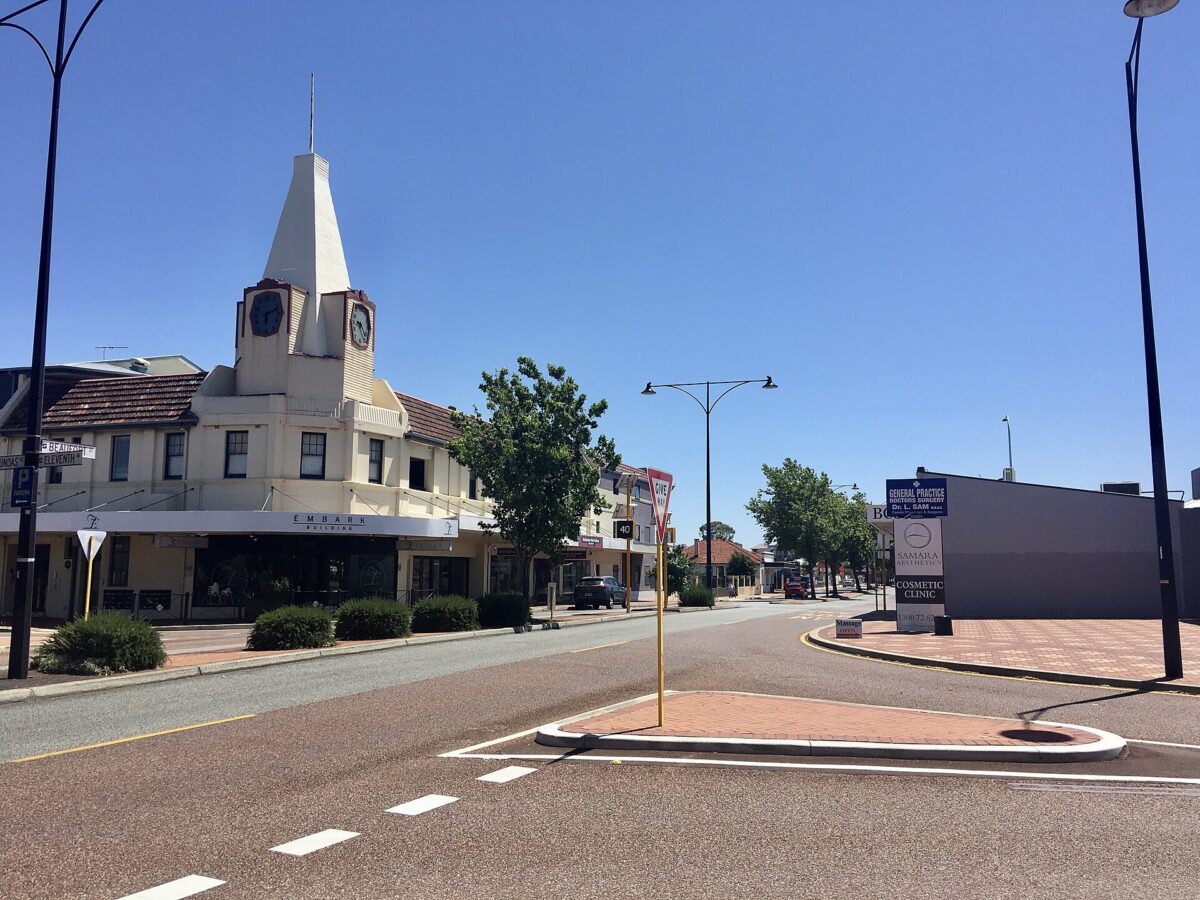
The clock tower on the corner of Beaufort Street and Dundas Road is the suburb’s best known landmark. Thomas James Snooks built the Piccadilly Gardens cinema complex in Inglewood.
The Inglewood Post Office at 885 Beaufort Street is an Art Deco building on the Commonwealth heritage list.
St Anne’s Private General Hospital was opened by the Sisters of Mercy in 1937.
The Inglewood Hotel opened in 1936, after residents had petitioned for a licence since 1929. It stands just over the border in Mount Lawley, and local legend says it took the Inglewood name because Lady Lawley agreed to her suburb’s name only if no hotel was built in it.
Inglewood today
Inglewood is in the City of Stirling. The Inglewood Civic Centre, with the library and community facilities, opened in 1991, and the council describes the suburb as having high heritage value.
More about Inglewood
For the suburb next door, read our Mount Lawley suburb profile and Mount Lawley history. If you own a property in Inglewood and are thinking about selling, start with buyers for your property.
Sources
- City of Stirling: Inglewood
- City of Stirling Art and History Collection: Inglewood
- inHerit: Inglewood Post Office
- Museum of Perth: Inglewood Post Office
- inHerit: Inglewood Hotel
- Inglewood Hotel: About Us
Dates and names are drawn from the sources above. Where sources differ, we have said so or given an approximate date.
By Key Performance Real Estate, 338 Beaufort Street, Perth
Category
Buying
Related Posts
Get an up to date obligation free market appraisal
One of our agents will visit your property to provide a professional, obligation-free market appraisal.