
Mount Lawley is one of Perth’s best known heritage suburbs, and much of what buyers love about it today, the tree-lined streets, the Federation and inter-war houses and the Beaufort Street strip, can be traced to a handful of decisions made between the 1890s and the 1910s.
How Mount Lawley got its name
The suburb is named after Sir Arthur Lawley, Governor of Western Australia in 1901 and 1902. The City of Vincent records that the suburb was formally proclaimed in 1901.
Before the suburb
The City of Vincent notes that the river land around today’s Banks Reserve was a Noongar meeting place and camp site with a connection to the Waugal, and that it appears on early maps as Warndoolier.
After colonisation the land was surveyed between 1833 and 1839 and granted to William Layton and John Gregory. Gregory ran the Pineapple Inn in the 1830s.
How it grew
The railway between Fremantle and Guildford passed nearby from the early 1880s, but the suburb itself began with subdivision. The first was in 1892, by the Sydney and Perth Land Building and Investment Company. Developers Copley and Robinson bought land in 1900, and their Mount Lawley Estates were released in stages in 1902 and 1912.
Copley and Robinson paid for a tram along Walcott Street, running by 1906, and the Mount Lawley railway subway followed in 1907. Trams ran along Beaufort Street until 1958.
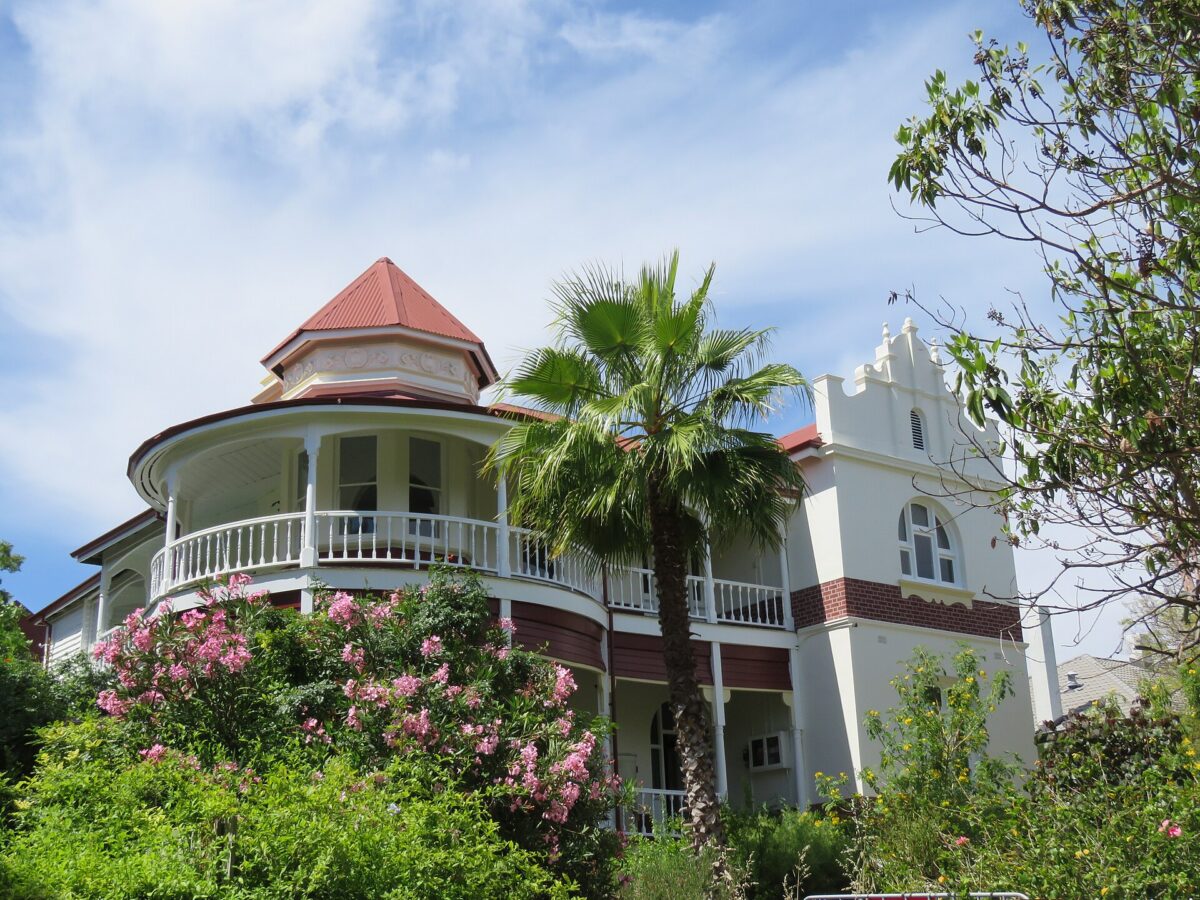
The City of Stirling records that most of the suburb’s traditional houses were built between 1910 and 1950, in Federation Bungalow, Federation Queen Anne, Arts and Crafts and Californian Bungalow styles. The streets of the two estates follow the natural fall of the land rather than a grid, and the area is now protected as a heritage area.
Places that tell the story
Hallyburton House on Walcott Street dates from 1893.
Windsor Hall in Queens Crescent is a 1903 Federation Free Style building by Henry James Prockter.
The Astor Theatre on Beaufort Street was built from 1914 as the Lyceum, became the State in 1922 and the Astor in 1941, and was remodelled in the Art Deco style. It is on the State Register.
The Waihemo Flats and the Beaucott Building (1938) are two of the area’s Art Deco survivors.
The Inglewood Hotel on Beaufort Street opened in 1936, after residents had petitioned for a licence since 1929. Local legend says Lady Lawley agreed to the suburb’s name only if no hotel was built in it, which is often given as the reason the hotel carries the name of neighbouring Inglewood.
Mount Lawley today
Mount Lawley sits across two councils, the City of Stirling and the City of Vincent. Beaufort Street grew as a shopping strip from the 1930s, and in 2009 the Beaufort Street Network became Western Australia’s first town team.
More about Mount Lawley
For what Mount Lawley is like to live in now, read our Mount Lawley suburb profile. If you own a property in Mount Lawley and are thinking about selling, start with buyers for your property.
Sources
- City of Vincent: Mount Lawley history
- City of Stirling: Mount Lawley
- City of Stirling: Mount Lawley heritage walk
- inHerit: Astor Theatre
- inHerit: Inglewood Hotel
- Inglewood Hotel: About Us
Top image: The Astor Theatre on Beaufort Street, 2004. Photo: Greg O'Beirne, CC BY 2.5, via Wikimedia Commons.
Dates and names are drawn from the sources above. Where sources differ, we have said so or given an approximate date.
By Key Performance Real Estate, 338 Beaufort Street, Perth
Category
Buying
Related Posts
Get an up to date obligation free market appraisal
One of our agents will visit your property to provide a professional, obligation-free market appraisal.