Guildford was one of the three towns laid out in the first year of the Swan River Colony. Its river landing, its convict-era buildings and the railway that ended its life as a port explain the town as it stands today.
How Guildford got its name
Landgate records that Captain James Stirling, sent by Governor Darling of New South Wales, explored the Swan River in 1827. He was impressed by the alluvial flats and took water from Success Spring at Success Hill, on the Bassendean side of the river. The junction of the Swan and Helena was chosen for a town, H.C. Sutherland made the first surveys late in 1829, and the town was named after Guildford in Surrey, where James and Ellen Stirling were married. The City of Swan gives a different reason, saying Stirling named it after his father-in-law’s electorate of Guildford in Surrey.
The Whadjuk Noongar name for the area is Mandoon. The City’s heritage policy for the town gives its meaning as place of many trees, and the City now calls the heritage area Guildford/Mandoon.
Before the suburb
This is Whadjuk Noongar country. The City of Swan describes Guildford, where the Swan meets the Helena River, as an important Noongar meeting place with campsites and spiritual sites, and the Helena River as a main route for Noongar people travelling to and from Guildford.
The City’s heritage policy notes that the Whadjuk valued the area for its tree canopy, its alluvial soils and the food sources on the floodplains, and that six registered Aboriginal heritage sites lie within or overlap the heritage area. Among the sites on the rivers is Devil’s Elbow, described as a resting place of the Waugal.
How it grew
Guildford was founded within months of the first settlers arriving in June 1829. Sutherland’s 1829 plan included Market Street, Swan Street and Stirling Square. Because Guildford was the furthest navigable point on the Swan River, it became an inland port linking Perth with the farming districts, and steamboats began running on the river in 1857.
In 1851 Guildford became a ticket-of-leave hiring depot for convicts. The court house and gaol on Meadow Street went up in stages between 1841 and 1866, and the Commissariat Store beside them was built in 1853 and 1854. The town was declared a municipality in 1871, with a crest of an anchor, a sheaf and grapes.
The Eastern Railway reached Guildford in 1881, and with it the river trade declined. In the 1890s the growth of Midland Junction took away much of Guildford’s commercial importance. During the Second World War the senior school of Guildford Grammar was taken over as a military hospital, first by the 5th Station American Army and then by the 2/1 Australian General Hospital, and in 1944 the first commercial flights left the Guildford Aerodrome in South Guildford, now Perth Airport.
Guildford Council merged with the Swan Road Board in 1960, and in 1970 that shire joined the Town of Midland to form the Shire of Swan. The National Trust classified Guildford as a historic town on 30 May 1984, and it was entered on the State Register of Heritage Places on 2 July 2019.
Places that tell the story
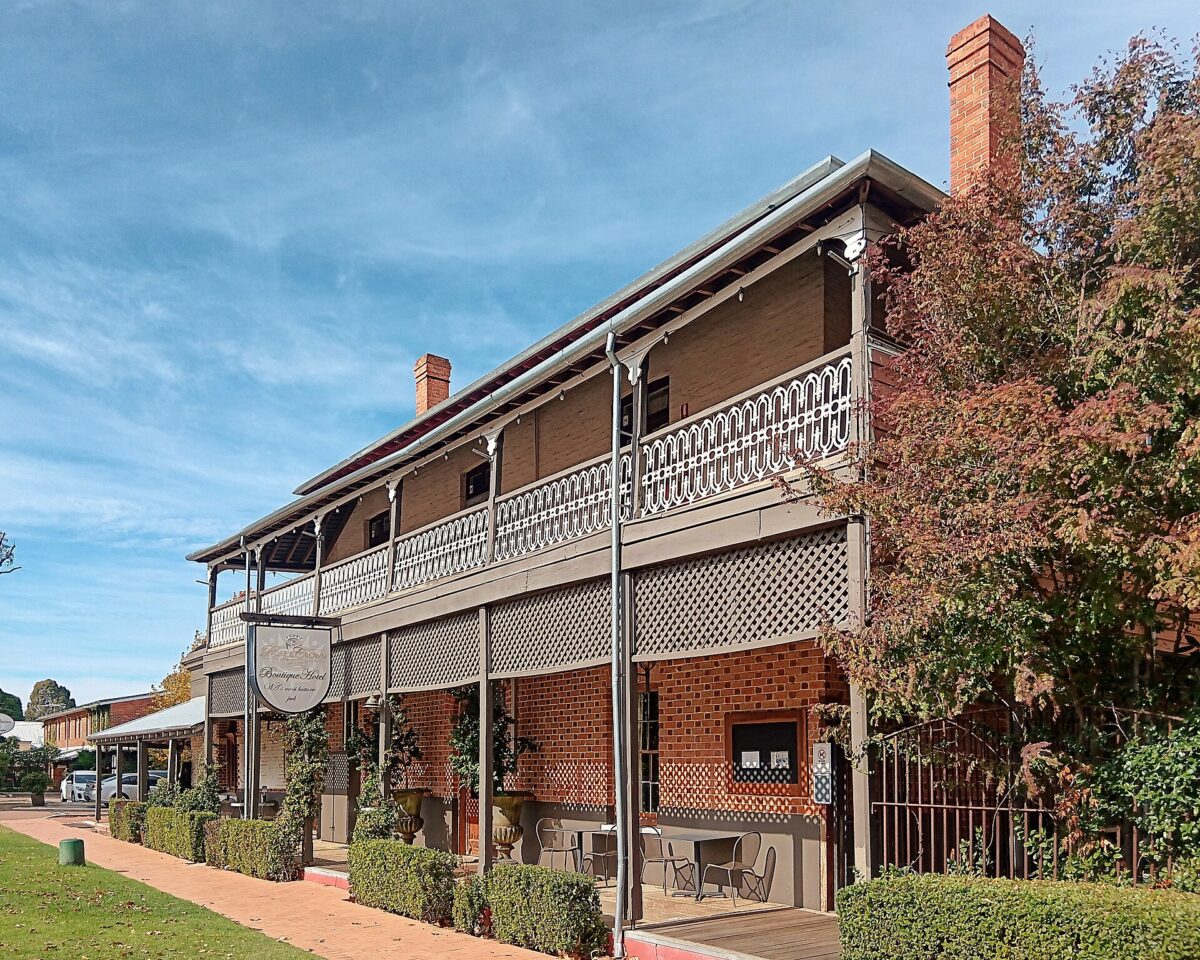
The Guildford Court House and Gaol on the corner of Meadow and Swan Streets was designed by Richard Roach Jewell, and the gaol served as a police station until 1969. Next door, the former Commissariat Store at 16 Meadow Street is now the Garrick Theatre. The Rose and Crown Hotel at 105 Swan Street began when Thomas Jecks, who had opened a store in 1839, added an inn in 1841. The town trust and the court met there in the early years.
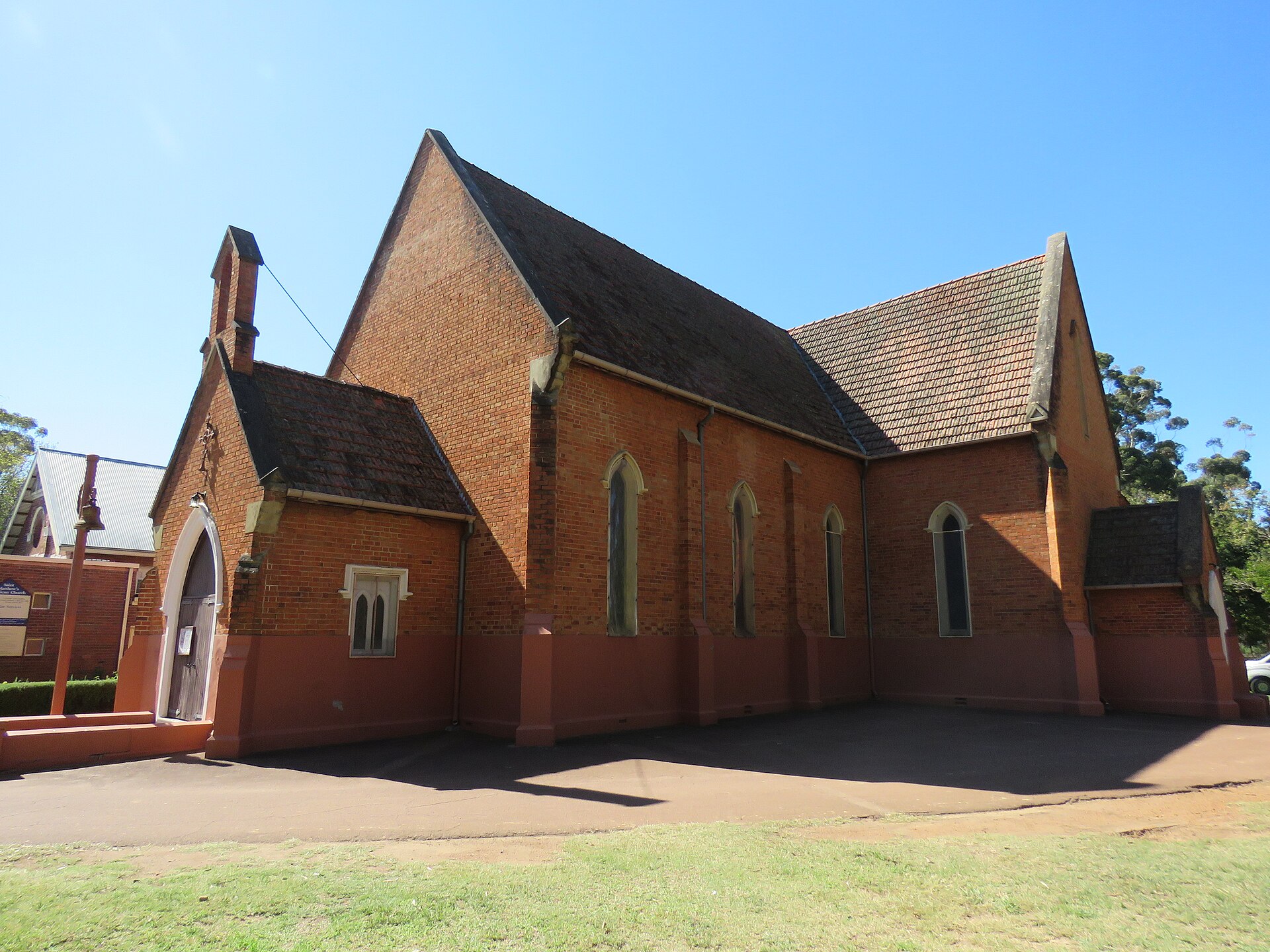
St Matthew’s Church was built in 1873 in the middle of Stirling Square. The Mechanics’ Institute dates from 1865, Padbury’s Store from about 1869, the post office from 1897 and the railway station building from 1898. The Guildford Hotel on the corner of James and Johnson Streets was built between 1886 and 1915. A fire in 2008 gutted it and destroyed its belvedere tower, but the facade was saved.
Guildford Grammar School began in 1896 in the billiard room of Woodbridge, the house of its founder Charles Harper. Its Chapel of St Mary and St George was consecrated on 25 March 1914.
Guildford today
The 2021 Census counted 2,040 people in Guildford. The City describes the town as one of the rarest and most intact historic towns in Australia, and most of it was built before 1945.
More about Guildford
For what Guildford is like to live in now, read our Guildford suburb profile. If you own a property in Guildford and are thinking about selling, start with buyers for your property.
Sources
- Landgate: Perth and surrounds suburb names (archived 2022)
- City of Swan: City history
- City of Swan: Post-settlement history of Guildford
- City of Swan: Aboriginal history
- City of Swan: Guildford/Mandoon Heritage Area Local Planning Policy, Part A
- City of Swan: Guildford/Mandoon Heritage Area Local Planning Policy, Part B (Character Statements)
- inHerit: Guildford Historic Town
- inHerit: Guildford Court House and Gaol (fmr)
- inHerit: Garrick Theatre
- inHerit: Rose and Crown Hotel
- inHerit: Guildford Hotel
- Swan Valley: Glorious Guildford brochure
- Guildford Grammar School: Our heritage
- ABS 2021 Census QuickStats: Guildford (WA)
Top image: The Rose and Crown Hotel, Guildford, 2026. Photo: Bahnfrend, CC BY-SA 4.0, via Wikimedia Commons.
Dates and names are drawn from the sources above. Where sources differ, we have said so or given an approximate date.
By Key Performance Real Estate, 338 Beaufort Street, Perth
Category
Suburb Histories
Related Posts
Get an up-to-date, obligation-free market appraisal
Get our professional, obligation-free opinion of your property’s value, with advice on how and when to sell.