
Part four of our series on strata levies and paperwork in Perth. This is where small Perth schemes differ most from large ones, and where a lot of confusion sits.
A duplex and a 61-lot building are both strata, and almost nothing about how they are run is the same.
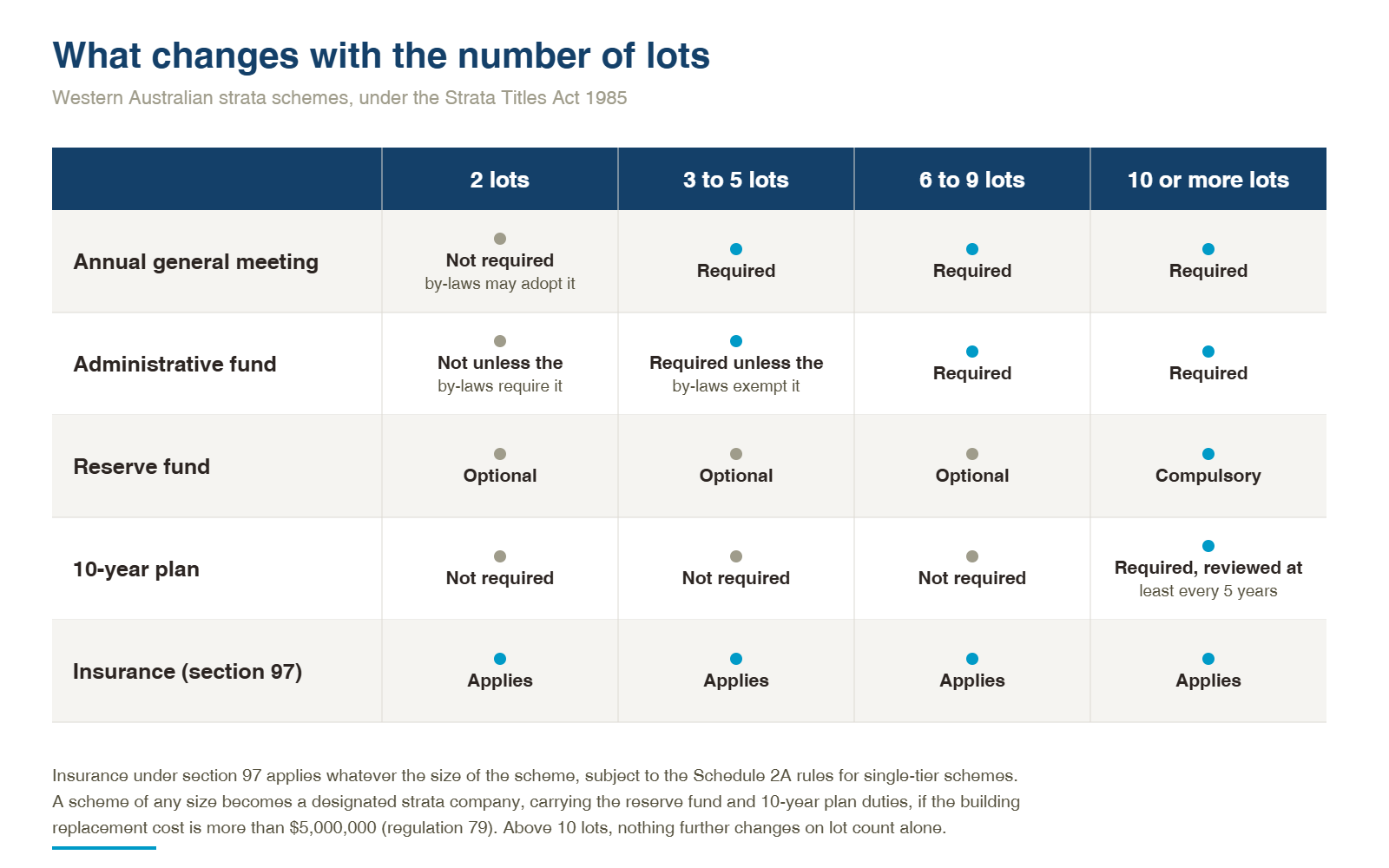
Designated functions, the term to know
Section 140 is headed Special rules for 2, 3, 4 or 5-lot schemes, and it works through a list the Act calls designated functions: the administrative fund, accounting records and the statement of account, minutes of meetings, the letterbox, and the roll.
Two-lot schemes
- The strata company may perform a designated function but is not required to, and it cannot establish an administrative fund unless the scheme by-laws require it (section 140(1)).
- It does not have to hold an annual general meeting, although it can make by-laws having the same effect (section 127(2)).
- It still has the section 97 insurance duty, subject to the single-tier rules covered in part three.
So in most duplexes there are no levies in the ordinary sense at all. The two owners deal with shared costs between themselves, and the insurance premium is usually the one that matters. The Act provides the machinery: where no administrative fund is maintained, the strata company or an owner who receives the premium notice can notify each owner of their share, worked out by unit entitlement or as the by-laws fix it, and require payment by a specified time. An unpaid share becomes a debt (Schedule 2A clause 53E).
Three, four or five-lot schemes
Here the scheme by-laws may exempt the strata company from those same designated functions (section 140(2)). The exemption has to be written into the by-laws. It does not happen on its own. Two four-lot villa complexes on the same street can therefore run quite differently, one with a proper administrative fund and accounts, the other with neither, depending entirely on what their by-laws say. Read the by-laws rather than assuming. Annual general meetings are still required at this size.
In any of these small schemes, a member can apply to the State Administrative Tribunal to require the strata company to perform a designated function despite section 140.
Ten lots or more
A scheme with 10 or more lots is a designated strata company (section 100(7)). Two duties follow:
- A reserve fund becomes compulsory rather than optional (section 100(2)).
- There must be a 10-year plan (section 100(2A)), revised at least once every 5 years and extended on revision to cover the following 10 years. Part five explains how to read one.
Above 10 lots, nothing further changes on lot count alone. A 12-lot scheme and a 120-lot scheme carry the same obligations, just at different scale.
The trap in small, expensive schemes
Lot count is not the only trigger. Regulation 79 extends designated strata company to a scheme where the building replacement cost is more than $5,000,000, and for a survey-strata scheme where the replacement cost of improvements on the common property is more than that figure.
A four-lot scheme of high-value apartments can therefore be caught by the reserve fund and 10-year plan duties while nowhere near 10 lots. Small does not automatically mean exempt.
Annual general meetings
A strata company must hold an annual general meeting once in each 12 month period, and not more than 15 months after its previous annual general meeting (section 127(1)). Those are two limits running at once, and the 15 month backstop runs from the last meeting, not from the end of the financial year.
Three things must be on the agenda of every AGM, including the first one: election of council members, consideration of the accounts, and presentation of copies of the current insurance certificates and schedules. Everything else transacted at an AGM counts as special business.
Between meetings, the functions of the strata company are performed by its council, subject to the Act and to any restriction imposed or direction given by ordinary resolution (section 135(1)). One council member must hold office as chairperson. Those functions can be performed by a strata manager instead, which is what happens in most schemes.
What does not change with size
The insurance duty in section 97 applies whatever the size of the scheme, subject only to the single-tier provisions. The administrative fund is compulsory for every strata company except where section 140 relieves a small one. And the $5,000,000 test is about value, not lot count.
The whole series
- Part 1. Which kind of strata scheme is it?
- Part 2. What your strata levies actually pay for
- Part 3. Who insures the building?
- Part 4. What changes with the size of the scheme (you are here)
- Part 5. How to read a 10-year plan
- Part 6. By-laws, and what unpaid levies mean at settlement
- Part 7. What a seller must tell you before you sign
This article is general information about how strata schemes work in Western Australia. It is not legal, financial or tax advice, and it is not a substitute for reading the scheme plan and the registered by-laws for the particular scheme. Rules change and every scheme differs. If something turns on it, check the scheme documents or get advice.
By James Yeoman, Director of KPR Perth Pty Ltd T/A Key Performance Real Estate
Related Posts
Get an up to date obligation free market appraisal
One of our agents will visit your property to provide a professional, obligation-free market appraisal.